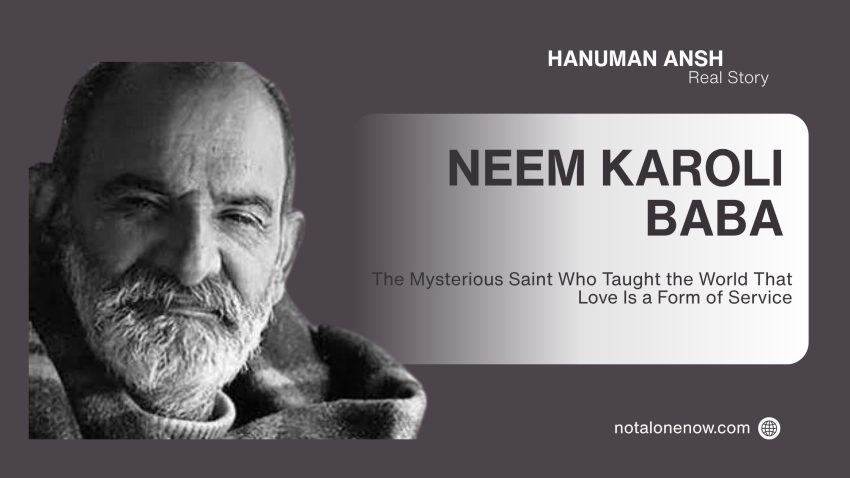
Neem Karoli Baba: The Mysterious Saint Who Taught the World That Love Is a Form of Service
From a wandering sadhu in Uttar Pradesh to the spiritual force behind Kainchi Dham, Ram Dass and a global movement of seva, discover the extraordinary life and timeless teachings of Neem Karoli Baba.

What if the greatest lesson of your life came from a man who wrote no books?
He gave no TED Talks.
He didn’t build a business empire.
He didn’t publish a philosophy.
He didn’t spend his life trying to convince the world that he was enlightened.
He simply sat wrapped in a coarse blanket, spoke when he wanted to, fed people who came to him, served those in need, remembered God—and somehow, people who had everything still travelled thousands of miles just to sit near him.
His name was Neem Karoli Baba, affectionately called Maharaj-ji by his devotees.
And perhaps the strangest thing about his story is this:
The more you try to define him, the more elusive he becomes.
His exact birth details are uncertain. His early life contains gaps. Many stories about him come through disciples and devotees rather than conventional historical records. He left no systematic body of teachings of his own.
Yet more than five decades after his death, people still travel to Kainchi Dham in Uttarakhand seeking his presence.
Why?
Who was this mysterious man?
And how did a relatively unknown Indian saint become a spiritual influence on people as different as a Harvard psychologist, a physician who later worked on one of the world’s greatest public-health campaigns, and generations of Western spiritual seekers?
To understand Neem Karoli Baba, you have to look beyond the miracles.
You have to look at what he made people become.
Who Was Neem Karoli Baba?
Neem Karoli Baba, also known as Neeb Karori Baba, was born as Lakshman Narayan Sharma around the beginning of the 20th century in Akbarpur, in present-day Uttar Pradesh.

Even his biography begins with uncertainty.
Sources differ on details of his early life, and much of what is known about him comes from devotees and accounts preserved after his death. Penguin Random House India, in discussing Ram Dass’s account of Baba, notes just how difficult he is to fit into an ordinary biography: there are relatively few hard facts and many stories surrounding his life.
According to traditional accounts, he left home as a young man and travelled as a wandering sadhu.
But his life did not follow the conventional image of a renunciate.
He eventually returned to family life, married, and had children.
And later, he became one of the most beloved spiritual figures associated with modern India.
He was deeply devoted to Lord Hanuman, and Hanuman bhakti became central to the spiritual culture surrounding him.
But if you expect lengthy philosophical lectures, you will find something surprising.
Neem Karoli Baba wasn’t interested in giving you a complicated philosophy.
His message was remarkably simple.
Love everyone.
Serve everyone.
Feed everyone.
Remember God.
That simplicity may be one of the reasons his teachings travelled so far.
The Saint Who Didn’t Look Like a Saint
Picture the image people often associate with spirituality.
A person sitting perfectly still.
Giving profound speeches.
Surrounded by scriptures.
Explaining complicated concepts about consciousness.
Neem Karoli Baba didn’t necessarily fit that picture.
He was known for his simple blanket, his unpredictable manner, his affection for food and prasad, and his extraordinary ability to make people feel that he saw straight through them.
He could be affectionate.
He could be stern.
He could appear completely ordinary.
And then devotees would describe an encounter they could not explain.
This is where the story of Neem Karoli Baba becomes difficult to separate into neat categories.
There is the historical Baba—the man who lived, travelled, established ashrams and died in 1973.
And then there is Maharaj-ji as experienced by his devotees—a figure associated with visions, impossible journeys, knowledge of people’s private thoughts, healing and other miraculous events.
Those miracle stories are an important part of his legacy, but they should be understood as devotional accounts, not as scientifically verified events.
And perhaps that distinction makes the story more interesting rather than less.
Because even if you put every supernatural story aside, something extraordinary remains.
The people who met him changed.
Kainchi Dham: The Place That Became His Spiritual Home
If you want to understand Neem Karoli Baba’s legacy, you eventually arrive at a small Himalayan valley in Uttarakhand.
Kainchi Dham.
Nestled in the Kumaon hills near Nainital, the ashram became closely associated with Maharaj-ji during the later years of his life.
The Hanuman temple at Kainchi was consecrated in 1964, and the ashram gradually became a major centre of devotion and service.
The setting itself seems almost deliberately removed from the noise of ordinary life.
Mountains.
Trees.
A river.
A narrow valley.
And a small temple complex that would eventually become known far beyond India.
But Kainchi Dham was not simply about meditation.
One of the recurring principles associated with Baba was seva—selfless service.
Feed people.
Help people.
Love people.
Don’t ask what you will get in return.
That distinction matters.
Because spirituality, in his tradition, wasn’t supposed to end when meditation ended.
It was supposed to become useful.
His Most Powerful Teaching Wasn’t About Miracles
Imagine meeting a spiritual teacher and asking:
“What should I do with my life?”
You might expect an elaborate answer.
Meditate for two hours.
Read this scripture.
Follow this ritual.
Give up everything.
Neem Karoli Baba’s legacy points somewhere much simpler:
Serve.
Feed someone.
Help someone.
Love someone.
Remember God.
And repeat.
This is why seva is so important in understanding his legacy.
The idea wasn’t merely to feel spiritual.
It was to turn spirituality into action.
That principle later travelled far beyond Kainchi Dham.
Then Came a Harvard Professor Who Wasn’t Looking for a Guru
This is where Neem Karoli Baba’s story takes an extraordinary turn.
In 1967, an American psychologist named Richard Alpert travelled to India.
Alpert was no ordinary traveller.
He had been a Harvard professor and had become well known through his work with Timothy Leary and research into psychedelics.
He had experienced intellectual success.
He had academic credentials.
He had explored altered states of consciousness.
But something was missing.
Then he met Neem Karoli Baba.
And the man who entered India as Richard Alpert eventually emerged as Ram Dass.
The name meant “servant of God.”
According to the Love Serve Remember Foundation, Alpert met Maharaj-ji in India in 1967, and the encounter became the turning point in his spiritual life.
But here’s the fascinating part:
Ram Dass didn’t merely become another disciple.
He became a bridge.
A bridge between an Indian spiritual tradition and millions of people in the West.
The Book That Carried Maharaj-ji’s Message Around the World
Neem Karoli Baba never wrote a book.
Yet one of the most influential spiritual books associated with the modern Western spiritual movement emerged directly from his relationship with Ram Dass.
Be Here Now.
Ram Dass published it in 1971.
And its central message was almost deceptively simple:
Be here.
Now.
Stop living entirely in yesterday.
Stop constantly rehearsing tomorrow.
Come back to this moment.
Ram Dass himself later explained that Maharaj-ji’s blessing and influence were deeply connected to the creation of the book.
The book went on to introduce generations of Western readers to meditation, yoga, bhakti, karma yoga and Eastern spirituality.
That means Neem Karoli Baba’s influence didn’t remain in a Himalayan ashram.
It travelled through a book.
And then through the people transformed by that book.
The Unexpected Legacy of Seva
There is another part of the story that deserves more attention.
Ram Dass wasn’t the only person influenced by Maharaj-ji.
One of his disciples was Dr. Larry Brilliant.
Brilliant later became involved with the World Health Organization’s smallpox eradication campaign.
According to accounts preserved by Neem Karoli Baba’s devotees, Baba encouraged Brilliant toward work that would serve humanity.
Whether one interprets the encounter spiritually or historically, the eventual trajectory of Brilliant’s life is remarkable: he became deeply involved in global public health and the effort that contributed to the eradication of smallpox.
And this is where Baba’s philosophy becomes tangible.
Spirituality wasn’t supposed to make you escape the world.
It was supposed to make you serve it.
The Famous Miracle Stories
No story about Neem Karoli Baba would be complete without discussing the miracles.
But this is where responsible storytelling matters.
Devotees have told countless stories about Maharaj-ji doing things that appear impossible.
Some describe him appearing in different places.
Others describe him knowing things he seemingly could not have known.
There are stories of healing.
Stories involving his famous blanket.
Stories of food multiplying.
Stories involving Ram Dass and his extraordinary experiences at the ashram.
Some of these accounts became central to books such as Ram Dass’s Miracle of Love, which collects stories about Maharaj-ji.
For devotees, these aren’t merely entertaining anecdotes.
They are leelas—expressions of divine play or grace.
But there is no independent scientific evidence establishing these supernatural events as historical fact.
And perhaps that is exactly how they should be presented.
You don’t have to believe every miracle story to understand why the stories matter.
Because they reveal something about how his followers experienced him:
not merely as a teacher, but as someone they believed could see beyond ordinary human limitations.
Why Was He So Obsessed With Feeding People?
Here’s a detail that can easily get buried underneath all the miracle stories.
Food mattered.
A lot.
Neem Karoli Baba’s ashrams became associated with feeding people and serving visitors.
The principle of annadaan—offering food as an act of generosity—is deeply rooted in Indian spiritual culture.
But in Baba’s world, feeding someone wasn’t a minor charitable gesture.
It was spiritual practice.
Someone arrives hungry?
Feed them.
Someone is suffering?
Help them.
Someone needs care?
Don’t ask whether they’re important enough.
Serve them.
That sounds incredibly ordinary.
And that’s precisely why it is powerful.
We often imagine spirituality as something extraordinary.
Baba’s message repeatedly brought it back to something painfully ordinary:
How do you treat the person standing in front of you?
He Didn’t Build a Religion Around Himself
Another fascinating aspect of Neem Karoli Baba’s legacy is what he didn’t leave behind.
He did not leave behind a massive philosophical system authored in his own name.
He did not produce a formal scripture.
He didn’t create a complicated doctrine that required people to understand him intellectually.
Instead, his legacy developed through:
- Ashrams
- Devotees
- Seva
- Hanuman bhakti
- Ram Naam
- Stories of his encounters
- The work of disciples such as Ram Dass
- A culture of feeding and serving people
That makes his influence unusual.
His teachings survived through people rather than books.
His Death Didn’t End the Story
Neem Karoli Baba died on 11 September 1973 in Vrindavan after becoming seriously ill.
His samadhi shrine remains associated with the Vrindavan ashram.
You might expect the influence of a guru to decline after his death.
The opposite happened.
His name continued spreading.
Kainchi Dham became increasingly well known.
Ram Dass continued teaching.
The principle of love and service travelled across continents.
And generations who never met Maharaj-ji began calling him their guru.
That is perhaps one of the strangest aspects of his legacy.
People who never saw him believe they were changed by him.
Why Do Entrepreneurs, Artists and Seekers Keep Finding Their Way to Kainchi Dham?
In recent decades, Kainchi Dham has attracted renewed international attention.
The ashram’s association with figures such as Steve Jobs and Mark Zuckerberg has helped turn it into a particularly recognizable destination for people interested in spirituality, technology and personal transformation.
But reducing Kainchi Dham to a “Silicon Valley secret” misses the bigger picture.
The ashram existed long before Silicon Valley discovered it.
Its foundation wasn’t entrepreneurship.
It was bhakti, seva and devotion.
The fascination comes from the contrast.
How can a simple Himalayan ashram connected to a man who lived without modern technology continue to attract people from a world obsessed with technology, money and achievement?
Perhaps because achievement eventually creates a question that achievement cannot answer:
“Now what?”
What Neem Karoli Baba Can Teach Young People Today
This is where his story becomes more relevant than ever.
Young people today are constantly being told to optimize themselves.
Build a personal brand.
Make money.
Get ahead.
Become successful.
Become extraordinary.
Neem Karoli Baba’s philosophy asks a completely different question:
What are you doing for somebody besides yourself?
That’s uncomfortable.
But maybe it needs to be.
1. Success without service can become empty
You can accumulate money, followers, qualifications and achievements.
But if none of it makes another person’s life better, what have you actually built?
2. You don’t need to be extraordinary to serve
You don’t need millions of followers.
Feed someone.
Help someone study.
Visit someone who is lonely.
Donate your time.
Listen.
Small acts of service can be more meaningful than grand declarations.
3. Stop chasing happiness as if it is a destination
Baba’s teachings point repeatedly toward love, remembrance and service rather than endless acquisition.
Sometimes happiness arrives as a side effect of doing something meaningful.
4. Spirituality isn’t necessarily escape
This may be one of the most important lessons.
You don’t have to disappear into the mountains to become spiritual.
You can practice spirituality in your home, workplace, family and community.
How you treat people is part of your spiritual practice.
5. Be present
The phrase associated with Ram Dass—Be Here Now—became famous because it captures something that modern life constantly destroys.
We are physically here.
But our minds are usually somewhere else.
Yesterday.
Tomorrow.
Our notifications.
Our anxieties.
Our ambitions.
Our regrets.
Being present is not laziness.
It is learning to actually inhabit your own life.
The Most Powerful Lesson May Be the Simplest One
Neem Karoli Baba’s life is surrounded by stories of miracles.
But perhaps the greatest miracle isn’t whether he could appear in two places.
It isn’t whether he could read someone’s thoughts.
It isn’t whether supernatural events happened around him.
The more interesting question is:
What happened to the people who met him?
Richard Alpert became Ram Dass.
A Harvard academic became a spiritual teacher.
Larry Brilliant went on to dedicate his career to global public health.
Thousands of ordinary devotees found a path centred on love, devotion and service.
And Kainchi Dham became a place where generations continued to gather.
That’s a legacy that doesn’t require supernatural proof.
Because it can be seen in the lives of people.
Neem Karoli Baba’s Legacy in One Sentence
If you stripped away the miracles, the mythology, the celebrity visitors and the stories…
you would still have this:
Love people. Serve people. Feed people. Remember God.
Perhaps that is why his message has survived.
Because it doesn’t require you to become Neem Karoli Baba.
It asks you to become a little more human.
In a world where everyone wants to be seen, he taught people to see others.
In a world obsessed with taking, he emphasized giving.
In a world chasing achievement, he pointed toward service.
And in a world constantly somewhere else…
he reminded people to come back to here and now.
Maybe that is the real reason people still climb the hills toward Kainchi Dham.
They aren’t necessarily looking for a miracle.
Perhaps they are looking for something much harder to find:
a reason to live with more love.
Frequently Asked Questions About Neem Karoli Baba
Who was Neem Karoli Baba?
Neem Karoli Baba, also called Maharaj-ji or Neeb Karori Baba, was a 20th-century Indian Hindu saint and devotee of Lord Hanuman. He became particularly associated with Kainchi Dham in Uttarakhand and was known for teachings centred on love, devotion and selfless service.
What is Neem Karoli Baba famous for?
He is famous for establishing and inspiring spiritual communities including Kainchi Dham, his devotion to Hanuman, his teachings on love and seva, and his influence on disciples such as Ram Dass. His life is also surrounded by numerous miracle stories preserved by devotees.
Was Neem Karoli Baba the guru of Ram Dass?
Yes. Richard Alpert, the American psychologist who later became known as Ram Dass, met Neem Karoli Baba in India in 1967. The encounter became a defining turning point in his life.
What does Neem Karoli Baba teach?
His teachings are commonly summarized around four ideas: love all, serve all, feed all and remember God. These teachings emphasize compassion, selfless service, devotion and remembrance.
What is Kainchi Dham?
Kainchi Dham is an ashram and Hanuman temple complex in Uttarakhand associated with Neem Karoli Baba. The temple was consecrated in 1964 and became one of the central places connected with his life and teachings.
Did Neem Karoli Baba perform miracles?
Numerous miracles are attributed to him by devotees, including stories of extraordinary journeys, healing and knowledge of events he seemingly could not have known. These accounts are an important part of his devotional legacy, but they are not independently established as scientific facts.
Final Thought
Perhaps the greatest question Neem Karoli Baba leaves us with isn’t:
“Did he perform miracles?”
It is:
“What miracle could happen if we actually followed his simplest teaching?”
Love someone.
Serve someone.
Feed someone.
Remember God.
And be here.
Now.
Related Posts

The Invisible Journey – The Mystical World of Neem Karoli Baba

Whisper in the Heart: The Ongoing Presence of Neem Karoli Baba
He Chose Hunger So Students Don’t Have to Choose Silence — The Ongoing Story of Sonam Wangchuk
Jagannath Rath Yatra: The Day God Comes Out to Meet His People
Chia Seeds vs Sabja Seeds: What’s the Real Difference & Which One Should You Choose?