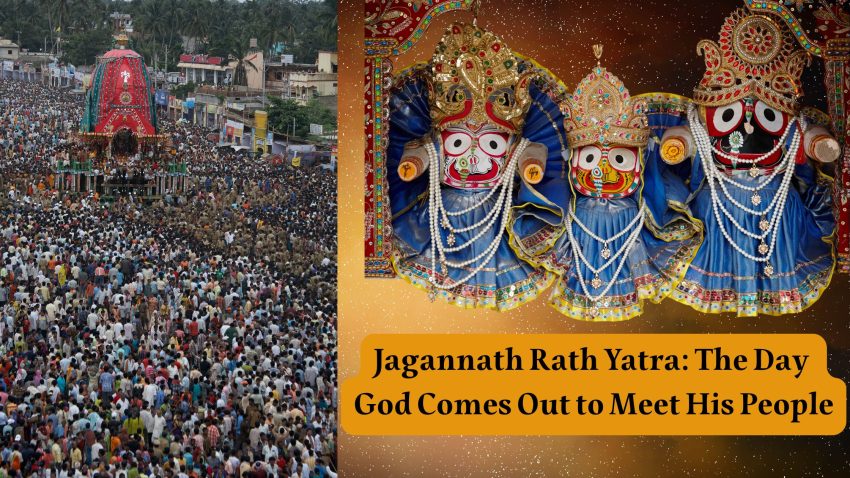
The untold layers of Rath Yatra—from a God who falls sick to a chariot that pauses for a devotee beyond religion.
Once a year, something extraordinary happens in Puri.
The doors of the temple open.
The gods step out.
And the streets turn into a sea of devotion.
This is the Jagannath Rath Yatra—one of the most powerful and emotional spiritual events in India.

But this isn’t just a festival.
It’s a moment where faith becomes visible.
But
Before the chariots roll… before the crowd gathers… before the world watches—
Something strange happens inside the temple of Jagannath Temple.
God falls sick.
Yes—Lord Jagannath, one of the most worshipped deities in India, is believed to fall ill, disappear from public view, refuse rituals…
…and only then begins the Jagannath Rath Yatra.
This is not just a festival.
It is one of the most layered, mysterious, and misunderstood spiritual events in the world.

The Part No One Talks About: When God “Falls Sick”
The story begins with Snana Yatra—a grand bathing ritual.
After being bathed with 100+ pots of water, the deities are believed to fall into a fever.
What follows is called Anasara:
- The temple doors close
- No darshan is allowed
- Priests treat the deities with herbal remedies
Think about that.
A God who:
- Gets sick
- Needs rest
- Withdraws from the world
This is deeply symbolic.
Divinity here is not distant or perfect—it is human, relatable, and alive.
The Rebirth Before the Journey
After days of isolation, the deities reappear during Netrotsava—when their eyes are repainted.
This isn’t just decoration.
It represents:
- Renewal
- Reawakening
- A “new vision” before stepping out into the world
And then…
The doors open.
The journey begins.
The Chariots Are Not Just Built—They Are Recreated
Every year, the three massive chariots are built from scratch.
Not restored. Not reused.
This is intentional.
- Wood is sourced from specific sacred trees
- Construction follows centuries-old measurements
- Even the number of wheels is fixed
The three chariots:
- Nandighosa (Jagannath)
- Taladhwaja (Balabhadra)
- Darpadalana (Subhadra)
This isn’t engineering.
It’s ritual architecture.
Creation itself becomes part of devotion.
The King Who Sweeps Like a Servant
Before the chariots move, something powerful happens.
The king of Puri performs Chhera Pahara—he sweeps the chariot with a golden broom.
A king… sweeping.
Not symbolically. Literally.
Because here:
Status collapses in front of the divine.
The Moment That Breaks Every Rule: Salabega
Now comes one of the most quietly powerful parts of Rath Yatra.
The chariot of Jagannath pauses near the samadhi of Salabega.
Salabega was:
- Born to a Muslim father
- Not allowed inside the temple
And yet, he became one of Jagannath’s most devoted followers.
His bhajans are still sung.
His devotion was so deep that, according to tradition:
The Lord waited for him.
Even today, the chariot is believed to pause at that spot.
No announcements. No drama.
Just a quiet reminder:
Devotion is not limited by identity.
The Real Meaning of the Journey: Why God Leaves the Temple
The deities travel from:
- Jagannath Temple
to - Gundicha Temple
Common explanation? Visiting their aunt.
Deeper meaning?
God refuses to stay confined.
Rath Yatra is one of the rare traditions where:
- The deity steps out
- The streets become sacred
- The boundary between “inside” and “outside” dissolves
Mahaprasad: The Kitchen That Never Discriminates
Now let’s talk about something even more fascinating.
The temple kitchen of Jagannath is one of the largest in the world.
Mahaprasad here:
- Is cooked in stacked earthen pots
- Uses firewood, not gas
- Feeds thousands daily
But here’s what makes it unique:
- No caste restriction
- Everyone eats together
- No “pure” vs “impure” segregation
This is radical—even today.
The “Spirits” Belief—Not What You Think
You may have heard:
“Food is also offered to spirits.”
Here’s the deeper, more accurate understanding:
Jagannath is considered universal—a deity of all existence.
So symbolically:
- Offerings are for all beings
- Including ancestors, unseen energies, and forgotten souls
This isn’t superstition.
It’s philosophy.
Nothing in existence is excluded from divine nourishment.
The Return Journey and the Sweet Stop
During Bahuda Yatra (return journey), the chariots stop at:
Mausi Maa Temple
Here, Jagannath is offered Poda Pitha—a rustic, homemade sweet.
Not royal food. Not elaborate offerings.
Simple. Earthy. Familiar.
Because this journey isn’t about grandeur.
It’s about connection.
The Golden Transformation: Suna Besha
After returning, the deities are decorated in gold ornaments.
This is called Suna Besha.
After:
- Falling sick
- Leaving the temple
- Traveling among people
They return… radiant.
Almost like a reminder:
Transformation comes after movement.
What Makes Rath Yatra So Different?
Let’s step back.
In most traditions:
- God is perfect
- God is distant
- God is untouchable
But here?
Jagannath:
- Falls sick
- Takes rest
- Leaves home
- Waits for a devotee
- Eats with everyone
- Returns transformed
This is not just worship.
This is a living relationship.
The Deeper Truth Most People Miss
Rath Yatra is not about chariots.
It’s about breaking boundaries:
- Temple vs outside
- Religion vs devotion
- Human vs divine
- Seen vs unseen
And maybe that’s why, even today, millions gather in Puri.
Not just to see God.
But to feel closer to something that doesn’t feel distant anymore.
Final Thought
If you look at Rath Yatra on the surface…
You’ll see a festival.
If you look a little deeper…
You’ll see philosophy.
But if you really understand it—
You’ll realize something powerful:
This is one of the very few traditions where God doesn’t ask you to come closer…
He comes to you.
Related Posts
Unsolved Mysteries of Jagannath Puri Temple
Struggling to Book Tirupati Darshan Tickets Online? Here is How!
Raghunandan Lyrics – Devotional Song of Lord Ram, Agam
Wahi Krishna Wahi Ram Hai Lyrics Krishna Bhajan
Chia Seeds vs Sabja Seeds: What’s the Real Difference & Which One Should You Choose?