Chhath Puja: The Festival Where We Thank the Sun, the River and Life Itself
The extraordinary story, rituals, mythology and deeper meaning of Chhath Puja — a four-day celebration where millions worship the setting and rising Sun with fasting, discipline and unwavering faith.
There is something almost hauntingly beautiful about Chhath Puja.
As the sun begins to disappear, thousands of people walk toward the water.
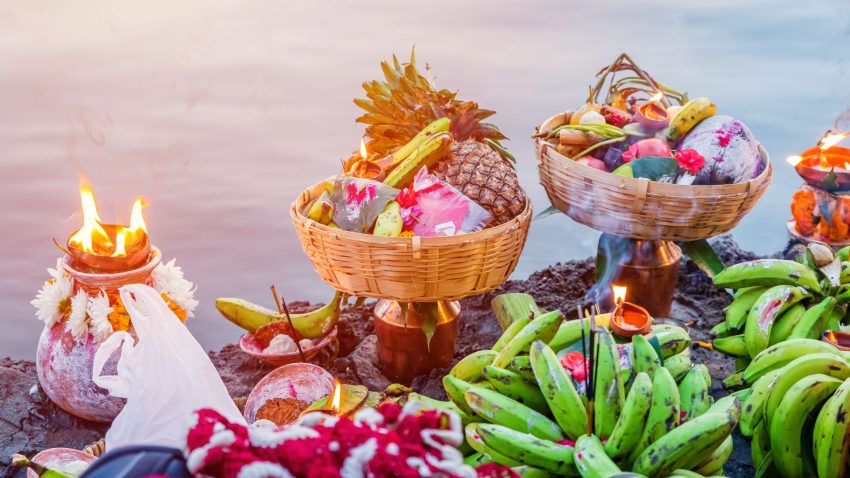
Some carry bamboo baskets filled with fruits and traditional offerings.

Some hold lamps.
Children walk beside their parents.
Folk songs rise above the crowd.
The water reflects hundreds of tiny flames.
And then something unusual happens.
People begin offering prayers to the setting Sun.
Not the rising Sun.
The setting Sun.
The Sun that is disappearing.
The Sun that has completed its journey for the day.
And perhaps that is the first lesson Chhath quietly teaches us:
We should be grateful not only for what is rising, but also for what is coming to an end.
Then, before dawn the next morning, the same people return.
They stand in cold water.
They wait.
And when the first rays appear on the horizon, they raise their hands and offer arghya to the rising Sun.
Two moments.
Sunset and sunrise.
Ending and beginning.
Darkness and light.
Life and renewal.
This is Chhath Puja — one of India’s most demanding, deeply rooted and visually extraordinary festivals.
And if you only know it as “the festival of Bihar,” you know only a fraction of its story.
What Is Chhath Puja?
Chhath Puja is a four-day Hindu festival primarily associated with Bihar, Jharkhand, eastern Uttar Pradesh and parts of Nepal. It is dedicated principally to Surya, the Sun, and also to Chhathi Maiya, traditionally associated with Shashthi Devi.
The festival is also known as Chhath, Chhath Parv, Dala Chhath and Surya Shashti.
The word Chhath is connected with the sixth day — Shashthi — of the waxing fortnight of the Hindu month of Kartik.
But unlike many festivals where worship takes place inside a temple, Chhath takes devotees outside.
To the river.
To the pond.
To the lake.
To the ghat.
To the open sky.
And that is significant.
There is usually no elaborate idol at the centre of the ritual.
No grand temple procession is necessary.
The devotee stands directly before nature.
Sun. Water. Earth. Human beings.
It is an extraordinarily intimate form of worship.
The Bihar Tourism Department describes Chhath as a major festival of Bihar and eastern Uttar Pradesh in which the setting Sun is worshipped alongside the rising Sun.
Chhath Puja 2026: When Is It?
In 2026, Chhath Puja will be observed from Friday, November 13 to Monday, November 16.
The four days are:
| Day | Date | Ritual |
|---|---|---|
| Nahay Khay | November 13, 2026 | Purification, bathing and a simple sattvik meal |
| Kharna | November 14, 2026 | Day-long fast followed by evening prasad |
| Sandhya Arghya | November 15, 2026 | Offering to the setting Sun |
| Usha Arghya | November 16, 2026 | Offering to the rising Sun and breaking the fast |
The exact sunset and sunrise times depend on location, so devotees should use the local panchang rather than copying a timing from another city.
But Where Did Chhath Puja Actually Come From?
This is where the story gets fascinating.
Ask where Chhath began, and you won’t find one universally accepted answer.
There are several layers to its history:
Vedic solar worship.
Ancient agrarian traditions.
Regional folk traditions.
Ramayana and Mahabharata legends.
Devotion to Chhathi Maiya.
And centuries of cultural evolution in the Gangetic plains.
It would therefore be misleading to say, “Chhath Puja was started by one particular person at one particular time.”
There is no universally accepted historical founding date.
What we can say with more confidence is that sun worship has very ancient roots in India, while the Chhath practiced today developed as a distinctive regional tradition, particularly in the middle Gangetic region.
The Rig Veda contains hymns dedicated to solar deities, but scholars caution against simply equating ancient Vedic Sun worship with the modern Chhath festival. A 2009 geographical study of Chhath specifically notes that although ancient India had strong solar-worship traditions, the present form of Chhath does not have a demonstrable direct link to those ancient practices.
Recent archaeological and ethnographic research has nevertheless pointed to fascinating parallels between Chhath’s ritual objects and practices and the long agricultural history of the Middle Ganga Plains — while also stressing that direct prehistoric continuity cannot be conclusively proven.
In other words:
Chhath may be ancient, but its history is more complicated — and more interesting — than a simple “thousands of years old” claim.
The Mythological Stories Behind Chhath
Like many living Hindu traditions, Chhath has accumulated several stories over generations.
And these stories are best understood as religious and cultural traditions, rather than as independently verifiable historical events.
The Ramayana Connection
One popular tradition connects Chhath with Lord Rama and Sita.
According to the belief, after returning to Ayodhya following their victory over Ravana, Rama and Sita observed a fast and worshipped Surya.
This association connects Chhath with the themes of purification, gratitude and renewal after a period of hardship.
The Mahabharata Connection
Another tradition connects Chhath with Draupadi and the Pandavas.
According to popular retellings, Draupadi performed Sun worship during the Pandavas’ difficult period and received divine blessings.
The Story of Karna
Then there is Karna, one of the most fascinating figures of the Mahabharata.
Karna was believed to be the son of Kunti and Surya.
Traditional stories portray him as a devoted worshipper of the Sun, offering prayers while standing in water.
This story is often cited as another connection between Sun worship and Chhath.
These stories have become part of the cultural memory surrounding the festival, although they shouldn’t be confused with a definitive historical account of how Chhath originated.
And Then There Is Chhathi Maiya
Perhaps one of the most interesting aspects of Chhath is that the festival isn’t simply about worshipping the Sun.
It also centres on Chhathi Maiya.
Depending on regional traditions and interpretations, Chhathi Maiya is associated with Shashthi Devi, a goddess connected with fertility, children and protection.
This is one reason Chhath carries such a strong emotional connection with families.
People pray for:
- The wellbeing of their children
- Health and longevity
- Family prosperity
- Fulfilment of wishes
- Protection of loved ones
- Gratitude for blessings already received
The relationship is deeply personal.
For many families, Chhath is not simply a festival.
It is a vow.
The Four Days of Chhath Puja
And now comes the part that explains why Chhath is often called one of India’s most rigorous festivals.
It isn’t a one-day celebration.
It is a four-day journey of discipline.
Day 1: Nahay Khay — Beginning With Purity
The festival begins with Nahay Khay.
The person observing the vrat, known as the vrati or parvaitin, takes a ritual bath and prepares a simple, pure meal.
Traditionally, cleanliness becomes extremely important.
The house is cleaned.
Cooking spaces are carefully prepared.
Food is made with ritual purity.
The idea is simple:
Before asking for blessings, purify yourself and your surroundings.
The Bihar government’s tourism portal describes Nahay Khay as the beginning of the four-day observance, involving bathing, cleanliness and preparation of the first ritual meal.
Day 2: Kharna — When Hunger Becomes Devotion
The second day is Kharna, also known in some traditions as Lohanda.
The vrati observes a fast during the day.
After sunset, the fast is broken with specially prepared offerings, commonly including kheer, roti and fruits, depending on local tradition.
But this isn’t the end of fasting.
It is only the beginning of the most demanding phase.
After Kharna, the vrati begins the long fast that continues through the evening arghya and into the following morning.
Day 3: Sandhya Arghya — The Moment That Makes Chhath Different
Now comes the heart of Chhath.
The entire community moves toward the water.
The vratis carry soop and daura — traditional bamboo baskets and winnowing trays — filled with offerings.
Among the familiar offerings are:
- Thekua
- Sugarcane
- Bananas
- Coconut
- Seasonal fruits
- Radish and other produce
- Lamps
- Traditional homemade prasad
Then the devotees enter the water.
And wait.
As the Sun approaches the horizon, the arghya begins.
Water is offered toward the setting Sun.
This is perhaps the most philosophically beautiful part of Chhath.
Most cultures instinctively celebrate beginnings.
The rising Sun.
The new opportunity.
The new year.
The new success.
Chhath asks us to bow before the setting Sun too.
To say:
Thank you for what you gave us.
Even before asking for tomorrow.
Why Does Chhath Worship the Setting Sun?
This question has fascinated people far beyond Bihar.
The setting Sun is not usually the symbol of victory.
It represents decline.
Yet Chhath doesn’t turn away from it.
Instead, devotees offer the same respect to the Sun as it disappears as they will offer when it rises again.
Some interpret this as a lesson in gratitude and humility.
Success deserves gratitude.
But so does the end of a journey.
Strength deserves gratitude.
But so does the period when strength is fading.
The philosophy can be summed up beautifully:
Don’t respect something only when it is powerful.
This interpretation isn’t the only religious explanation for the ritual, but it captures something profound about the festival’s emotional symbolism.
Day 4: Usha Arghya — Waiting for the First Light
After spending the night observing the fast, devotees return before sunrise.
They stand in the water.
They wait.
The horizon begins to brighten.
And then the first rays appear.
The final offering — Usha Arghya — is made to the rising Sun.
Only after this ritual is the fast concluded.
The Bihar Tourism Department describes Usha Arghya as the final stage of Chhath, after which devotees break their fast and distribute prasad among family, neighbours and friends.
And suddenly, after days of preparation and discipline, the festival ends with something deceptively simple:
sharing food.
The 36-Hour Fast: What Makes Chhath So Demanding
The fasting tradition associated with Chhath is famous for its severity.
After Kharna, many vratis observe a nirjala fast, meaning they abstain from both food and water until the morning arghya.
This can last roughly 36 hours, depending on the local sunset and sunrise.
But there is an important point that is sometimes lost online:
Not everyone is expected to perform the strictest form of the vrat.
Chhath is a deeply personal religious observance, and practices can vary between families and communities.
People with medical conditions, pregnant women, children, older adults or anyone who may be medically vulnerable should not attempt prolonged fasting without appropriate medical guidance.
Faith should never require someone to ignore serious health risks.
Thekua: The Prasad That Tastes Like Chhath
Ask someone who grew up celebrating Chhath what they remember, and there’s a good chance thekua will appear somewhere in the answer.
Made traditionally using wheat flour, jaggery or sugar and ghee, thekua is one of the most recognizable offerings associated with the festival.
It isn’t just food.
It carries memory.
A grandmother making it.
A mother preparing it before dawn.
Children waiting impatiently.
Baskets being packed.
Neighbours exchanging prasad.
And after the final arghya, the same food that was offered to the divine becomes something shared with everyone.
That is another beautiful idea hidden inside Chhath:
What you offer is eventually shared.
Chhath Is Not Just a Festival. It Is Community in Action.
Here’s something you may miss if you only watch Chhath through photographs.
The festival requires an enormous amount of collective effort.
Someone cleans the ghat.
Someone arranges the water body.
Someone prepares the prasad.
Someone makes bamboo baskets.
Someone brings fruits.
Someone lights the lamps.
Someone sings.
Someone helps elderly devotees.
Someone carries the offerings.
The entire neighbourhood becomes involved.
Recent ethnographic research describes Chhath as a form of “lived religion” in which ritual objects, embodied practices, family relationships and community participation help transmit the tradition from one generation to another.
That’s why Chhath can feel bigger than the people actually observing the fast.
Everyone participates in some way.
The Women Who Carry the Tradition
Chhath is often associated with women, particularly women who undertake the vrat for the wellbeing of their families.
But here’s an important correction to a common misconception:
Chhath is not exclusively a women’s festival.
Men also observe the vrat.
Official district cultural information notes that although women are commonly the principal worshippers, Chhath is not gender-specific and many men also perform the rituals.
Still, women have historically played a particularly important role in preserving and transmitting the festival’s knowledge.
They pass down:
- Songs
- Recipes
- Ritual rules
- Preparation methods
- Folk stories
- Family traditions
In many households, Chhath becomes one of the strongest ways cultural knowledge moves from grandmother to mother to daughter.
It isn’t written in a textbook.
It is lived.
The Forgotten Environmental Side of Chhath
This may be one of the most fascinating aspects of the festival.
Chhath takes place around water.
Rivers.
Ponds.
Lakes.
Ghats.
And cleanliness is not merely decorative.
Preparing for Chhath traditionally involves cleaning homes and public spaces and preparing the places where rituals will take place.
That creates a fascinating connection between spirituality and ecology.
A recent archaeological and ethnographic study argues that Chhath preserves material and ritual elements reflecting an agrarian worldview connected to rivers, agriculture, seasonal cycles and natural resources. The authors are careful not to claim a proven direct line from prehistoric communities to today’s festival, but the ecological parallels are striking.
Think about the message:
You cannot perform a water-centred festival while treating water as worthless.
At least, you shouldn’t.
And perhaps that is one of Chhath’s most relevant lessons for the modern world.
The things we call sacred should also be the things we protect.
Chhath and the Sun: Is There a Scientific Meaning?
You’ll often find claims online that Chhath’s rituals are scientifically designed to provide particular health benefits.
Some of those claims are exaggerated.
There is no good reason to turn a religious practice into a collection of unsupported scientific promises.
But there is a genuine ecological and cultural observation worth making.
Human life depends upon:
Sunlight.
Water.
Food.
Agriculture.
Seasonal cycles.
Chhath places all of these at the centre of its ritual world.
The festival’s offerings include agricultural produce.
Its rituals occur around water.
Its central object of devotion is the Sun.
Its timing follows a seasonal calendar.
So even without inventing “scientific miracles,” the underlying worldview is clear:
Human beings are not separate from nature.
We depend on it.
And Chhath asks us to remember that dependence.
Chhath Is Also a Story of Migration
There is another reason Chhath has become so powerful.
It travelled.
For generations, people from Bihar, eastern Uttar Pradesh and neighbouring regions migrated to cities across India in search of education, employment and opportunity.
They carried Chhath with them.
Delhi.
Mumbai.
Kolkata.
Surat.
Bengaluru.
Industrial towns.
Then eventually, other countries.
Suddenly, a festival rooted strongly in the Gangetic plains was appearing beside rivers and lakes far away from Bihar.
Research on Chhath’s geography describes precisely this transformation: a regional tradition carried by migration into metropolitan and industrial cities, gradually becoming much more widespread.
And this is why Chhath means so much to migrants.
When you’re thousands of kilometres from home, a festival can become more than a festival.
It becomes a piece of home you can carry with you.
Chhath Puja Is Now Global
Today, Chhath is celebrated by diaspora communities around the world.
The images can feel surreal.
A festival born in the cultural landscape of the Gangetic plains…
being performed beside waterways in foreign cities.
Different country.
Different skyline.
Same songs.
Same bamboo baskets.
Same thekua.
Same prayer.
Same Sun.
The setting may change.
The emotion doesn’t.
Why Chhath Is So Emotionally Powerful
Perhaps Chhath survives because it speaks to something deeply human.
We all want our families to be healthy.
We all fear losing people we love.
We all want our children to have good lives.
We all experience uncertainty.
We all hope.
Chhath gives those emotions a ritual form.
You wake before sunrise.
You prepare.
You sacrifice.
You wait.
You pray.
You offer.
And finally, you share.
There is no instant gratification.
And perhaps that’s precisely why it feels so powerful in an age that has become addicted to instant gratification.
The Real Meaning of Chhath Puja
Strip away the crowds.
The songs.
The social media photographs.
The elaborate decorations.
Even the mythology.
What remains?
A human being standing in water before the Sun.
With nothing between them and nature.
No complicated philosophy.
No elaborate intellectual argument.
Just gratitude.
Thank you for the light.
Thank you for the water.
Thank you for food.
Thank you for life.
And perhaps:
Please give me the strength to protect what you have given me.
That is why Chhath is more than a festival.
It is a reminder of our dependence on forces far greater than ourselves.
What Young India Can Learn From Chhath
For younger generations, Chhath offers lessons that have surprisingly little to do with religion.
1. Gratitude should include the sunset
We celebrate success.
But can we also be grateful when something ends?
2. Discipline is a form of strength
Chhath doesn’t happen because someone felt motivated for one afternoon.
It requires preparation, patience and discipline.
3. Community makes difficult things possible
No one has to carry the entire festival alone.
People contribute.
They help.
They share.
4. Nature isn’t just a resource
Sunlight, water and food aren’t abstract commodities.
They are the foundation of life.
5. Traditions survive when people practice them
Culture isn’t preserved by saying, “Our ancestors did this.”
It survives when someone teaches the next generation how to do it.
6. Success isn’t the only thing worthy of celebration
Chhath’s worship of the setting Sun offers perhaps the most beautiful reminder of all:
There is dignity in endings too.
Chhath Puja: A Festival That Looks Backward and Forward at the Same Time
Maybe that’s why Chhath has survived.
It looks backward through ancient stories, family traditions and generations of songs.
But it also looks forward.
Toward another sunrise.
A healthier family.
A better harvest.
A fulfilled vow.
A new beginning.
And somewhere between the setting Sun and the rising Sun lies the entire human experience.
We arrive.
We live.
We lose.
We hope.
We begin again.
That is Chhath.
Not merely a festival of the Sun.
A festival of gratitude.
A festival of discipline.
A festival of family.
A festival of nature.
A festival of migration and belonging.
And ultimately, a festival reminding us of something modern life makes incredibly easy to forget:
We are alive because we are connected to something much larger than ourselves.
Frequently Asked Questions About Chhath Puja
What is Chhath Puja?
Chhath Puja is a four-day Hindu festival dedicated primarily to Surya, the Sun, and associated with Chhathi Maiya/Shashthi Devi. It is especially prominent in Bihar, Jharkhand, eastern Uttar Pradesh and Nepal.
When is Chhath Puja in 2026?
The four-day Chhath observance in 2026 runs from November 13 to November 16, with Sandhya Arghya on November 15 and Usha Arghya on November 16.
Why is the setting Sun worshipped during Chhath?
Chhath uniquely includes an offering to the setting Sun as well as the rising Sun. The ritual is commonly understood through ideas of gratitude, humility, renewal and respect for the Sun’s life-giving power in both its declining and rising phases.
Who is Chhathi Maiya?
Chhathi Maiya is traditionally associated with Shashthi Devi, a goddess connected in popular belief with fertility, children and protection. Different regional traditions offer different interpretations of her identity and role.
Is Chhath Puja only for women?
No. Women are often prominent among the vratis, but men can and do observe Chhath as well. The festival is not inherently restricted to women.
How long is the Chhath fast?
The strict fast after Kharna is commonly described as lasting about 36 hours, often without food or water, until the morning Usha Arghya. Practices can vary, however.
What food is offered during Chhath?
Traditional offerings commonly include thekua, fruits, sugarcane, coconut and other seasonal produce. Kharna offerings often include kheer and roti, depending on family and regional customs.
Is Chhath Puja mentioned in the Ramayana and Mahabharata?
Chhath traditions are associated in popular religious narratives with figures including Sita, Rama, Draupadi, the Pandavas and Karna. These are devotional traditions and should not be treated as a single historically verified account of the festival’s origin.
Final Thought
The next time you see a photograph of Chhath Puja, don’t just look at the beautiful sunset.
Look closer.
At the mother standing waist-deep in water.
At the father carrying the bamboo basket.
At the child holding a small lamp.
At the grandmother singing a song she learned from her own grandmother.
At the thousands of people waiting patiently for the first ray of sunlight.
And remember what they’re really doing.
They’re saying thank you.
Not just for success.
Not just for wealth.
Not just for tomorrow.
But for the most basic miracle of all:
being alive.
Related Posts
Who is Neem Karoli Baba – The Real Hanuman Ansh Story
He Chose Hunger So Students Don’t Have to Choose Silence — The Ongoing Story of Sonam Wangchuk
75 Emotional Healing Affirmations That Actually Help You Feel Better (Not Just Sound Good)
Jagannath Rath Yatra: The Day God Comes Out to Meet His People
Weakness Leaves Me Lyrics Fearless Motivation